911 Targa (991) - A return to the classics

The classic is back and it’s more beautiful than ever! The Porsche 911 Targa of the 991 generation says goodbye to the large sunroof concept and proudly returns to the iconic design of 1967. With a massive roll-over bar, panoramic rear glass, and a revolutionary mechanism that folds the roof in 19 seconds, the Targa defines a new category of style.

The 911 Targa of the 991 generation marks a fundamental return to the legacy of the original 1967 Targa. While the previous 993, 996, and 997 generations used more of a large sliding sunroof concept, the 991 series revives the iconic design with a fixed roll-over bar and characteristic rear glass. The result is a technically sophisticated car that combines a classic look with modern mechanics.

Although Porsche kept the Targa designation for previous generations, the original idea of a removable panel had disappeared. These versions did not gain significant popularity, and by the end of the 997 production run, they accounted for less than 10% of total sales. Porsche realized that the Targa needed a return to its roots, but without the inconvenient manual handling of the roof.
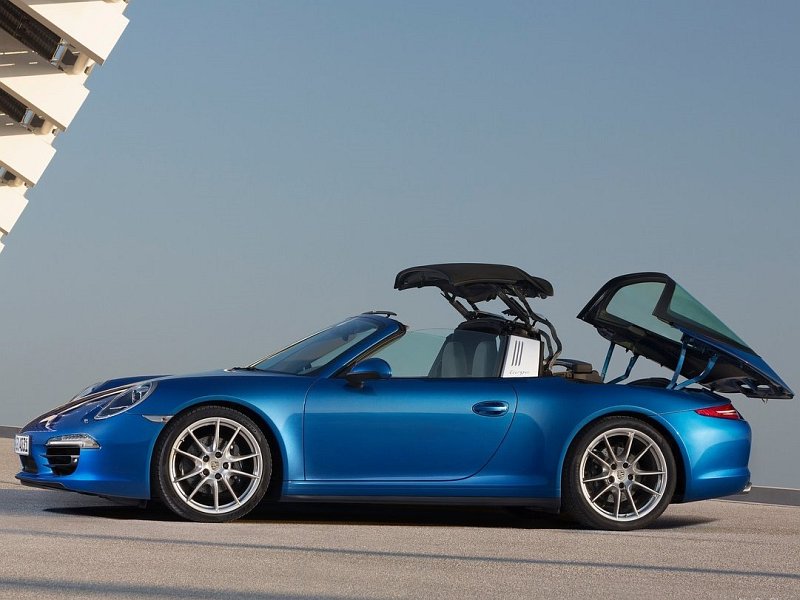
The solution is a fully automated roof mechanism, which is one of the technical highlights of the 991 generation. The rear glass tilts back, the fabric roof—composed of magnesium panels—elegantly moves over the aluminum bar and is stowed under the rear window. The entire process takes 19 seconds, resulting in an impressive mechanical choreography that is unparalleled in the automotive world.

The 991 Targa is available exclusively with all-wheel drive and offers two engine variants. The base Targa 4 has a 3.4-liter flat-six engine with 350 hp, allowing for acceleration from 0 to 100 km/h in 4.6 seconds and a top speed of 280 km/h. The more powerful Targa 4S features a 3.8-liter flat-six with 400 hp, which, with the PDK transmission and Sport Chrono package, accelerates from 0 to 100 km/h in 4.2 seconds and reaches a top speed of up to 296 km/h. The chassis is specifically tuned so that, despite the open-top concept, the car retains the typical precision and stability of the 911 model.

Compared to the Carrera 4S, the Targa 4S feels softer and more comfortable. This fits its role as a stylish, year-round usable GT. The wide body of the all-wheel-drive versions is standard, and there is a choice between a seven-speed manual transmission or the dual-clutch PDK. Compared to the coupe, the Targa is 113 kg heavier, and 38 kg heavier than the cabriolet.
With the roof up, the interior is almost as quiet as in the coupe; the mechanism is perfectly hidden, and the fabric upholstery feels high-quality. At higher speeds, slight vibrations may occur, which Porsche partially eliminates with a retractable wind deflector on the windshield.
The new 991 Targa is more than just a sports car—it is a technical work of art. While the previous 996 and 997 generations were only a niche affair on the market, the 991 version, thanks to its retro-modern look, is poised to become an absolute hit. If you are looking for a machine that evokes emotions just by opening the roof in a parking lot, the Targa 4S is an unrivaled choice in 2014.
| 911 Targa 4 (991) | 911 Targa 4S (991) | |
|---|---|---|
| Engine type | 6-cylinder boxer | 6-cylinder boxer |
| Displacement | 3436 cc | 3800 cc |
| Power | 257 kW (350 HP) at 7400 rpm | 294 kW (400 HP) at 7400 rpm |
| Torque | 390 Nm at 5600 rpm | 440 Nm at 5600 rpm |
| Top speed | 282 km/h | 296 km/h |
| Acceleration (0-100 km/h) | 5.2 s | 4.8 s |
| Average consumption | 9.5 l/100 km | 10 l/100 km |
| Base price | 109,338 euros | 124,094 euros |


15.1. 2014