Porsche and Le Mans - legendary cars and famous personalities

The 24 Hours of Le Mans is not just a race. It is a test of engineering, strategy, human endurance, and courage that has defined the pinnacle of endurance motorsport since 1923.

Every June, drama unfolds at the Circuit de la Sarthe in Le Mans, France, where the ability to endure an entire day and night at maximum pace is the deciding factor. This is where legends are born, and no brand has been as closely linked to this race as Porsche. The race traditionally starts on Saturday at 4 PM, and over the course of 24 hours, day turns to night, dry turns to rain, and favorites turn into the defeated. While racing categories have changed throughout history, the overall victory has always remained the most precious trophy. Porsche has 19 of them to its name, making it the most successful brand in the history of Le Mans.

The race has also attracted famous personalities who approached motorsport with passion and respect. Behind the wheel of Porsche cars, we have seen the likes of Paul Newman, who started in 1979 with Dick Barbour's Porsche 935 and finished second overall; Nick Mason, the drummer of Pink Floyd; and Mark Thatcher, son of British Prime Minister Margaret Thatcher. Patrick Dempsey, an actor and long-time Porsche ambassador, also holds a special place in history, having participated in Le Mans repeatedly with his Dempsey Racing team.

Another famous figure associated with Le Mans is Steve McQueen. Although he never officially competed in the race, his 1971 film Le Mans, in which he drove a Porsche 917, forever linked the race with Hollywood iconography. McQueen's relationship with Porsche and endurance racing helped bring the atmosphere of Le Mans to millions of viewers around the world and significantly contributed to the brand's myth.

Czech drivers and teams have also left their mark here. The most significant Czech success of the modern era came in 2009, when Tomáš Enge of the Aston Martin Racing team secured fourth place in the GT1 class at the 77th running of the race. In the same year, Porsche celebrated a victory in the LMP2 class with the RS Spyder prototype, which was one of the most technically advanced customer racing cars in the world at the time.

The RS Spyder, originally developed for the American ALMS series, confirmed its reputation at Le Mans as a machine capable of beating the factory prototypes of other brands. For Czech fans, this was a year where the best Czech result in history symbolically met with another Porsche triumph. It was not only the best Czech result in the history of Le Mans but also an extraordinary performance in the context of strong factory competition. Moreover, the crew was the fastest of all gasoline-powered cars, which, in an era dominated by Audi diesel prototypes, underscored the exceptional nature of this result.

Czech names have also appeared directly behind the wheel of Porsche cars, especially in the GT categories. Jaromír Janiš competed at Le Mans as part of customer teams, where they fought not only against the competition but also against the physical and mental exhaustion typical of a 24-hour race. Similarly, Robert Pergl and Tomáš Kostka represented Czech colors in classes where Porsche traditionally relied on the long-proven technology of the 911 model line. The Porsche customer program played a key role in allowing drivers from smaller racing nations to stand on the Le Mans starting grid with competitive equipment. Porsche did not act merely as a manufacturer here, but as a partner that enabled private teams to achieve world-class results.

Porsche first appeared at Le Mans in 1951 with the 356 SL Coupé. It could not dream of an overall victory at the time, but it won its class in its very debut. This was the path the brand followed—not through an immediate triumph, but through the systematic gathering of experience, technical development, and perseverance. For Porsche, motorsport was not an advertisement, but a development laboratory.

In the following years, the brand regularly succeeded in smaller displacement categories and built a reputation as a reliable manufacturer whose cars often crossed the finish line just as stronger rivals dropped out.

The real turning point came on June 14, 1970. After years of effort, Porsche finally reached the absolute summit. Hans Herrmann and Richard Attwood drove the 917 K to victory. Nineteen years after its first start, Porsche became the overall winner of Le Mans.

Hans Herrmann, nicknamed "Lucky Hans" for his ability to survive serious accidents, promised his wife shortly before the race that if he won, he would retire. He kept his promise. An era of dominance was beginning for Porsche—for him personally, it was the end.
A year later, Porsche repeated the triumph, this time with the crew of Helmut Marko and Gijs van Lennep, again with the 917 model. This car, born from the courage of Ferdinand Piëch, became one of the most iconic racing cars of all time. Piëch himself later described the 917 project as the riskiest step of his career.

After the departure of the 917, a new chapter began. In 1976, the open-top 936 Spyder prototype, powered by a turbocharged flat-six engine, made its debut. It won on its first start and became the first turbocharged car ever to win Le Mans. The main figure of this era was Jacky Ickx. The Belgian, one of the greatest legends of motorsport, won Le Mans with Porsche a total of four times—in 1976, 1977, 1981 with the Porsche 936, and in 1982 with the Porsche 956. His ability to read the race, conserve the equipment, and simultaneously drive on the edge perfectly matched the Porsche philosophy.

The year 1979 brought one of the most remarkable stories in Le Mans history. While the factory Porsche 936 cars dropped out, the overall victory was secured by the private team Kremer Racing with the Kremer 935 K3. The crew consisted of Klaus Ludwig and brothers Don and Bill Whittington.
It was the last time a Porsche customer team won Le Mans, and also the first victory for a rear-engined car. However, the Whittingtons' story has a dark background; their racing careers were financed by illegal activities related to drug smuggling, but the technical and sporting significance of the victory remains indisputable.

The eighties belonged entirely to Porsche cars. The 956 model and later the 962 dominated endurance racing around the world. In 1982, Porsche occupied the entire podium at Le Mans. Among the winners of this era, we find names like Derek Bell, Al Holbert, Hans-Joachim Stuck, Jochen Mass, and Jacky Ickx once again. The Porsche 956 and 962 became the benchmark for endurance prototypes—fast, efficient, and nearly indestructible.

In 1998, Porsche returned to the top with the 911 GT1. Although it bore the iconic designation, it was a pure-bred prototype with a carbon monocoque. In a dramatic duel with the Toyota GT-One, the crew of Laurent Aïello, Stéphane Ortelli, and Allan McNish won, and Porsche claimed its 17th overall victory, symbolically in the year of the brand's 50th anniversary.
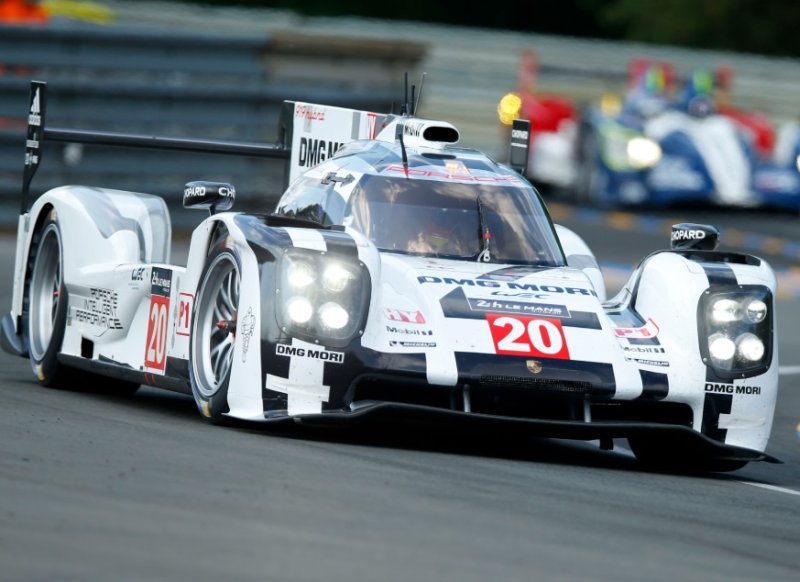
The latest chapter of dominance is represented by the 919 Hybrid. The brand's technological pinnacle combined an internal combustion engine with electric motors and sophisticated energy recovery. After an unsuccessful debut in 2014, the perfect answer followed: victories at Le Mans in 2015, 2016, and 2017, each time supplemented by World Championship titles for both drivers and manufacturers. After 2017, Porsche left the top class to focus on the electric Formula E. But its legacy at Le Mans remained untouched.
Le Mans and Porsche are inseparably linked today. Not just by the number of victories, but above all by the way they were achieved: through technical invention, perseverance, and a long-term vision. From the modest class successes of the fifties to the hybrid triumphs of the 21st century, the story of Porsche at Le Mans is the story of a brand that never stopped believing that endurance is more than speed.
Overview of Porsche's overall victories at the 24 Hours of Le Mans
| Year | Drivers | Model |
|---|---|---|
| 1970 | Hans Herrmann / Richard Attwood | 917 K Coupé |
| 1971 | Gijs van Lennep / Helmut Marko | 917 K Coupé |
| 1976 | Jacky Ickx / Gijs van Lennep | 936/76 Spyder |
| 1977 | Jürgen Barth / Hurley Haywood / Jacky Ickx | 936/77 Spyder |
| 1979 | Klaus Ludwig / Don Whittington / Bill Whittington | Kremer 935 K3 Coupé |
| 1981 | Jacky Ickx / Derek Bell | 936/81 Spyder |
| 1982 | Jacky Ickx / Derek Bell | 956 Coupé '82 |
| 1983 | Vern Schuppan / Hurley Haywood / Al Holbert | 956 Coupé '83 |
| 1984 | Henri Pescarolo / Klaus Ludwig | 956B Coupé |
| 1985 | Klaus Ludwig / Paolo Barilla / John Winter (Louis Krages) | 956B Coupé |
| 1986 | Derek Bell / Hans-Joachim Stuck / Al Holbert | 962C Coupé |
| 1987 | Derek Bell / Hans-Joachim Stuck / Al Holbert | 962C Coupé |
| 1994 | Yannick Dalmas / Hurley Haywood / Mauro Baldi | Dauer 962 Le Mans |
| 1996 | Davy Jones / Alexander Wurz / Manuel Reuter | TWR WSC-95 |
| 1997 | Michele Alboreto / Stefan Johansson / Tom Kristensen | TWR WSC-95 |
| 1998 | Yannick Dalmas / Allan McNish / Stéphane Ortelli | 911 GT1 Evo 98 |
| 2015 | Earl Bamber / Nick Tandy / Nico Hülkenberg | 919 Hybrid (9R9) |
| 2016 | Marc Lieb / Romain Dumas / Neel Jani | 919 Hybrid (9R9) |
| 2017 | Timo Bernhard / Brendon Hartley / Earl Bamber | 919 Hybrid (9R9) |


10.3. 2023